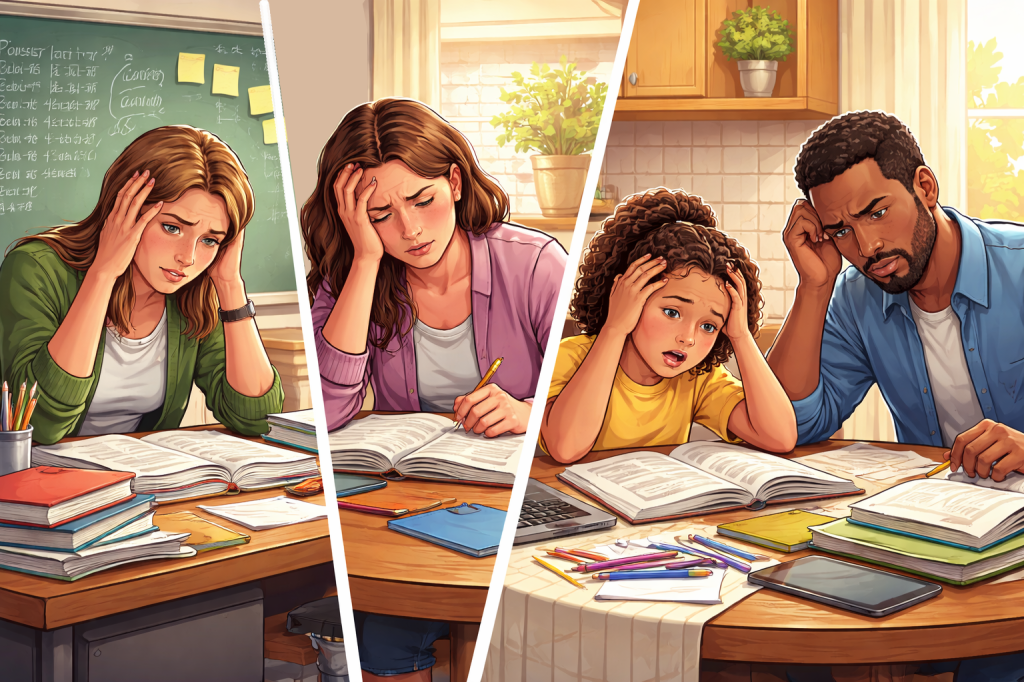
Homework in elementary school is one of those “normal” practices we rarely stop to interrogate.
It has been around forever. Families expect it. Schools defend it. And kids drag it home in crumpled folders after a full day of doing their best to hold it together.
Lately I have been seeing the homework debate flare up again, and I get why. Parents are exhausted. Kids are overstimulated. Teachers are overloaded. And we are still asking the same question.
Why are we sending children home from a 7.5-hour school day with more school?
So let’s dig into the elementary angle, because the thinking and logic around homework changes as kids get older. High schoolers can benefit from independent practice in ways that younger students often cannot. The research and the lived reality do not land the same for a first grader as they do for a junior in Algebra II.
Homework is not one single thing.
It can be purposeful practice, or it can be busywork. It can be doable, or it can be impossible. The impact depends on who the child is and what their home looks like.
What the research actually suggests (especially for elementary)
One of the most-cited bodies of research on homework comes from Harris Cooper and colleagues. Across large meta-analyses, the pattern is consistent. The relationship between homework and achievement gets stronger as students get older. In the elementary grades, the academic effect is small to negligible.
The American Psychological Association’s overview of the homework research landscape reflects the same mixed reality. Homework can have benefits, but it also comes with real drawbacks, including stress, burnout, and less time for family and activities. Those tradeoffs matter more when kids are young.
That does not mean “never send anything home.” It means we should be honest about the question we are really asking. Is this helping learning, or is it extending compliance?
Why schools still push homework anyway
Even when the benefits are unclear for younger kids, homework sticks around for reasons that have very little to do with actual learning.
1) It is tradition. Homework is baked into the identity of “real school.” If a school reduces it, some families interpret that as lowering expectations, even if the school is making a developmentally sound choice.
2) It is a visibility tool. Homework is proof of work. It makes learning “show up” at home. That can feel reassuring to adults, even when the assignment is not the best way to build skills.
3) It is used as a pacing lever. Teachers have standards to cover, limited time, and classes with wide academic ranges. Homework can become a pressure valve. We did not finish, so it goes home. That is understandable. It is also where equity breaks.
4) It is treated like virtue. Many adults grew up believing homework builds responsibility and grit. Researchers and critics disagree on whether homework actually teaches those traits in young children, or whether it teaches that learning is something you do when you are tired and resentful.
The equity problem no one can wish away
Here is the part that bothers me the most. Graded homework assumes a child has the same home resources as every other child.
Some children go home to a calm space, an adult who can help, supplies, internet, time, and emotional bandwidth. Other children go home to responsibilities, chaos, fatigue, language barriers, housing insecurity, or caregivers who are working nights. Some kids have no academic support at home, not because families do not care, but because they are surviving.
When homework is graded, it can quietly become a grading system for privilege.
If homework requires adult help to succeed, it is not measuring student learning.
It is measuring which students have access to adult help.
And even when homework is not graded, the emotional message still lands. You are behind because you did not do it. That is a heavy burden for a child who did not have a fair shot at doing it in the first place.
Who benefits, advanced students vs typical learners vs struggling learners?
For advanced students: homework is often either unnecessary repetition (busywork) or it becomes a way to accelerate without support. Teach yourself this tonight. Neither is ideal. The best “advanced learner” work is usually deeper thinking, richer reading, creative projects, and meaningful exploration, not more worksheets.
For typical learners: practice can help, but only if it is short, targeted, and actually doable independently. If a child needs instruction to complete it, it is not practice. It is unfinished teaching.
For struggling learners: homework is often where discouragement compounds. If school already felt hard, homework can turn into an evening-long reminder of “I can’t.” For some kids, it creates conflict at home and reinforces a self-image of failure.
The research landscape is nuanced, but this much is hard to ignore. The younger the child, the more likely homework costs outweigh academic gains.
The emotional crush: restraint collapse, after-school dysregulation, and real life
If you have spent time around young children, you have seen it. Many kids hold themselves together all day and then unravel at home. Some families call it restraint collapse. Others just call it the after-school meltdown. The label matters less than the reality. A full school day is cognitively and emotionally demanding.
Kids manage expectations, transitions, noise, social stress, academic pressure, and constant correction. By dismissal, many are running on fumes. Asking for more structured academic output at home can be the final straw, especially for children with anxiety, ADHD, autism, sensory needs, or trauma histories.
And if homework is graded, that pressure does not just sit on the child. It spills into the home. The family becomes the enforcement system.
This is why I did it differently when I taught third grade
When I taught third grade, “homework pages” were often just practice pages, the kind we used during the lesson while I was right there to support students. They had time in class to work. They could ask questions. I could correct misconceptions in the moment.
And yes, there was motivation. Finish your work, then you get to go outside. It was not punishment. It was structure.
Most importantly, it did not fracture learning into two worlds. School learning happened at school, with teachers. Home could be home.
So is homework so important that it is a problem that needs a solution?
For elementary students, I would argue the better question is this. Why are we clinging to a tool with limited proven benefit for young kids when the cost is so obvious? Stress. Inequity. Family conflict. Reduced play. Reduced rest.
If a school wants something at home, there are alternatives that tend to be more developmentally appropriate.
Reading (time, not logs; joy, not policing)
Short fluency practice for kids who truly need it (1 to 5 minutes, not 45)
Optional enrichment (“if you want to…”) rather than required compliance
Family conversation prompts (language growth without worksheets)
Homework does not have to be the hill we die on. For younger children, the “solution” might be simpler. Stop treating homework as the default.
What teachers can do instead (without adding more to your plate)
I know the reality. Teachers are pressured to raise scores, cover standards, prove rigor, and keep families informed. So when I say “do something else,” I am not saying “do more.” I am saying shift the work back into the classroom where it belongs.
Here are options that work in real life.
1) Build practice time into the lesson.
If the assignment matters, carve out time for it while you are present. Even ten minutes of supported practice lets you catch misunderstandings before they harden. It also removes the equity issue of who has help at home.
2) Use “must do, may do” in class.
Give students a short, targeted “must do” and then optional “may do” extensions for early finishers. The advanced students get depth. The typical learners get enough practice. Struggling learners get supported repetitions instead of taking the hardest part home.
3) Replace homework with reading, and keep it human.
Encourage daily reading, but do not turn it into policing. If you need accountability, keep it simple. A weekly “tell me about what you read” circle, a book talk, a partner share, or a quick note about a favorite part.
4) Send home micro-practice only when it truly fits the child.
Not a packet. Not a worksheet stack. A tiny, targeted practice for a specific skill, for a specific student, when it can reasonably be done independently. Think one page. Think five minutes. Think success.
5) Make home learning optional, not punitive.
If you want to provide extra practice, label it as optional. Put it in a “practice if you want it” section or a “family choice” menu. Remove shame. Remove grades. Let families decide what their evenings can hold.
6) Use feedback loops that do not punish home circumstances.
If something goes home, do not grade it in a way that tanks a child’s average. Use it as information. Who needs reteach? Who needs a different strategy? Who is overwhelmed?
7) Protect play and recovery as part of learning.
Kids need downtime to process the day. They need movement. They need joy. They need family connection. Those are not extras. They are the foundation that makes learning possible tomorrow.
A challenge I would love schools to consider
If we are going to assign homework in elementary school, it should meet a higher bar.
1) It can be done independently by the child.
2) It is short and targeted.
3) It is not graded in a way that punishes home circumstances.
4) It has a clear purpose that is better than what could have been done in class.
If it does not meet that bar, maybe it does not belong in backpacks.
And if you are a parent reading this, I will say this gently and clearly.
If homework is crushing your evenings, you are not failing. If your child melts down after school, that is not a character flaw. It is a nervous system that has been working hard all day.
Home should not feel like a second shift of school.
Kids are allowed to be done.
References: Cooper, H., Robinson, J. C., & Patall, E. A. (2006). Does Homework Improve Academic Achievement? A Synthesis of Research, 1987–2003. Review of Educational Research. American Psychological Association. (2016). Is homework a necessary evil? Monitor on Psychology.
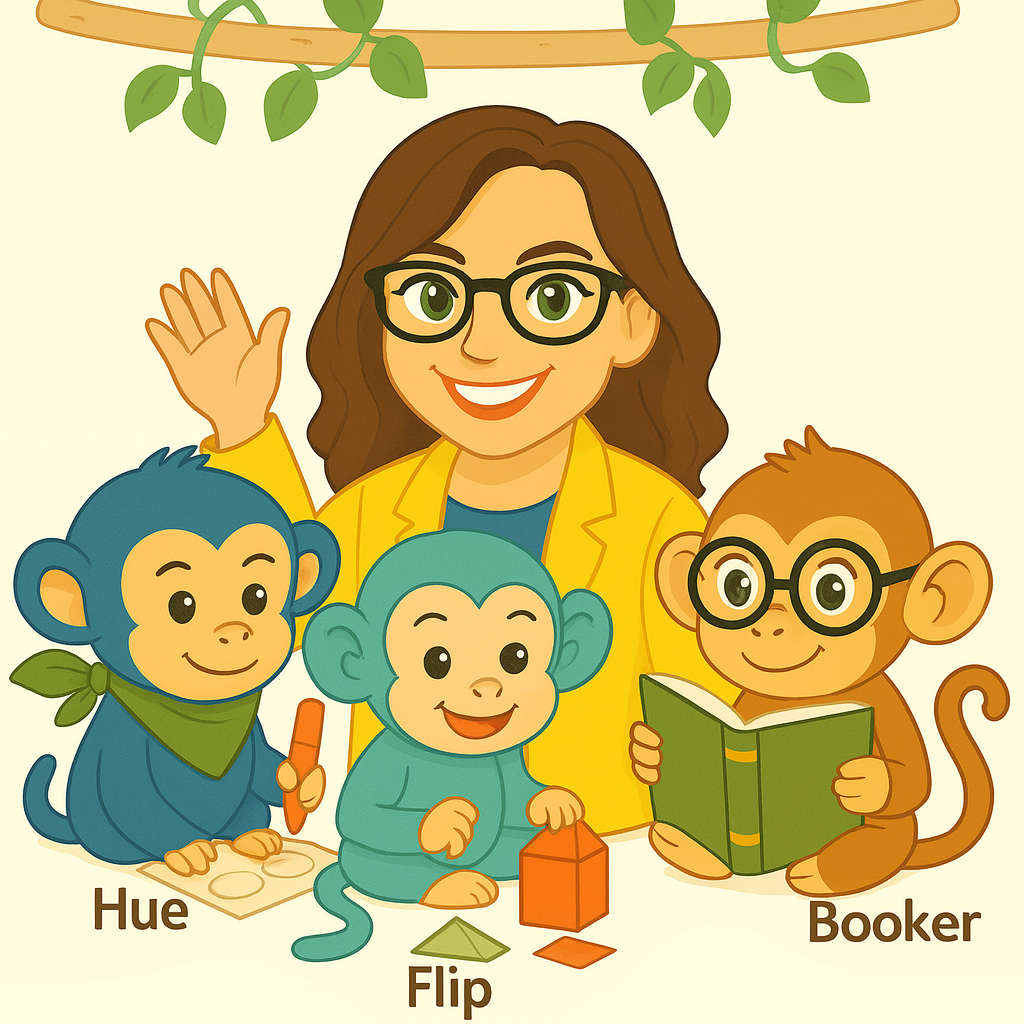 About Chrissi: Hi, I’m Christina “Chrissi” Dennis, B.Ed., M.A. (ABA). I’m a teacher, writer, and creator of Monkey Buddies Activities and books. I’m passionate about helping kids grow, supporting parents, finding and nurturing our villages, and creating a healthy balance between classroom life and family life.
 chrissidennis.com
Leave a comment