When Repeated Words Are Communication
A micro-blog for teachers and families
A child says, “Time to go,” in the middle of centers. It would be easy to hear the repetition, decide it does not fit the moment, and redirect the child back to the blocks.
But what if it does fit the moment?
There may be a slew of possibilities when a child repeats a phrase. Maybe they are finished. Maybe the room has become too loud. Maybe “time to go” is the closest language they have for “I want to leave this activity, area, or noise.” Or maybe they simply enjoy saying it. It is our job to learn to discern that.
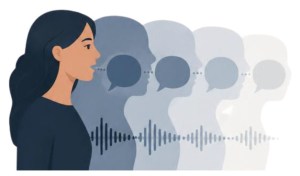
That repeated or scripted language is called echolalia. It is common among children with autism, and it is not necessarily meaningless noise that adults should ignore or stop. A newly published pilot study worked with preschoolers with autism who use echolalia by teaching adults to notice the child’s words, respond to them, offer useful language models, and create natural opportunities for communication.
The study was very small—only two children—so it does not hand teachers an intervention plan. It does reinforce a valuable starting point: curiosity.
Instead of asking, “How do I get them to stop repeating that?” we might ask, “What could these words be doing for this child right now?”
Teachers do not need to become speech-language pathologists or claim to decode every script. The same phrase can mean different things at different times. Our job is simpler: notice the context, acknowledge the child, offer clear language that fits the moment, and observe.
Families matter enormously here. A phrase that sounds random at school may come from a favorite movie, a bedtime routine, a grandparent, or an experience the teacher knows nothing about. Parents may recognize its history immediately. Teachers, meanwhile, see when the phrase appears during transitions, peer play, noise, meals, or frustration. Each adult holds information the other does not.
I have seen this firsthand. A phrase learned from a show, book, or song can be used to express a real need or feeling at school. One child repeatedly said, “Oh no!” In this case, the child was expressing dismay because she wanted a snack and could not find one in her book bag. She had learned the phrase from a television show but used it appropriately to express how she felt at school.
I learned the origin of the phrase only by sharing her day with her mother. We had developed a strong school-to-home relationship to support the child. Together, we were able to recognize what “Oh no!” meant in that moment and model more specific language when it was helpful.
That is why trust must go both ways. Parents should be able to trust that teachers bring professional knowledge and careful classroom observation. Teachers should also trust that families know their own child in ways no one else can. We need both perspectives.
Sometimes a child’s words begin to make sense only after the adults stop trying to prove who understands the child best and compare what they know.
Source
Nico, J., Sauceda, A., Branaman, J., & Gevarter, C. (2026). Adapting NDBIs for Autistic Children Who Use Echolalia: A Cascading Coaching Approach to Supporting Communication and Language Development. Behavioral Sciences, 16(9), 1553. https://doi.org/10.3390/bs16091553

