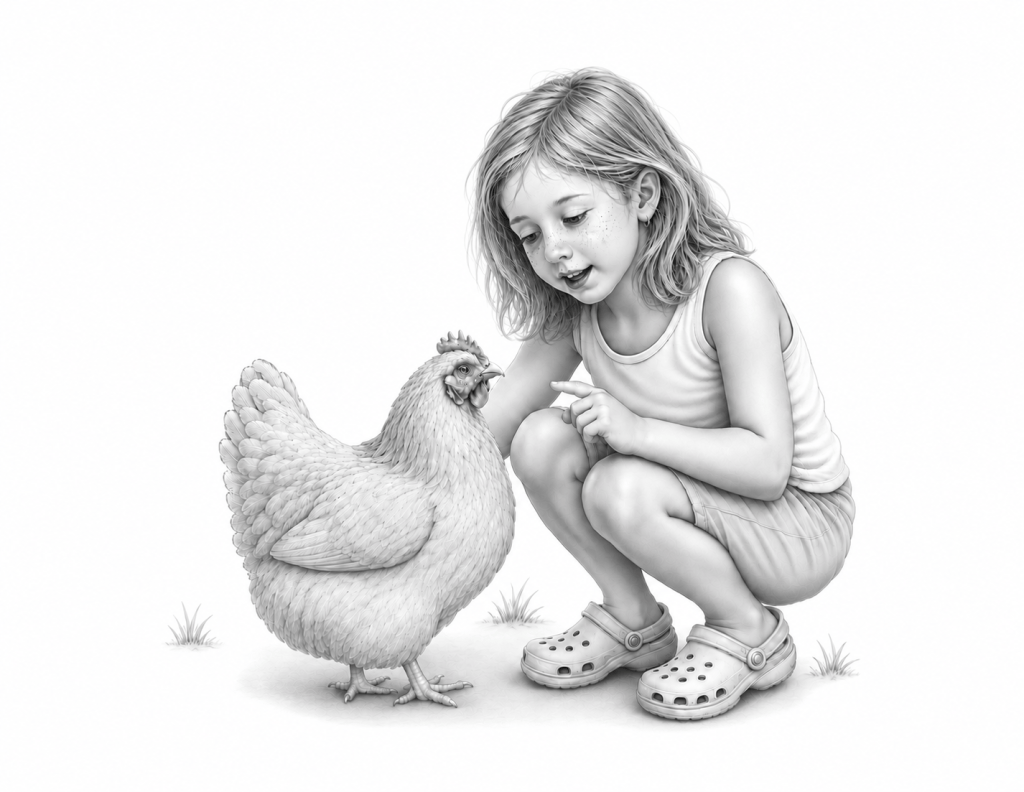
A page can look almost finished until it’s not. A suspicious ankle, a missing cat paw, and then everything starts looking wrong and there goes your confidence.
I am slowly but surely working through the illustrations for my latest (and never-ending) children’s book. I started Cluck Cluck Chaos (tentative title) two years ago. My little protagonist, Layla, has turned two more years, and here I am, FINALLY satisfied with the illustrations and feeling more confident.
My biggest struggle has been ensuring the pages reflect the exact energy I want to convey. The faces are good (so good), the body composition is accurate, and the animals look like animals rather than cartoon characters of animals. I feel good about capturing the energy of a little girl and her affection for chickens. The story about a girl who wants to take her chicken inside for bedtime, “just this once Mom”, was written for a real-life little chicken-loving child. All the details that go into partnering with AI are finally, and mostly, coming together.
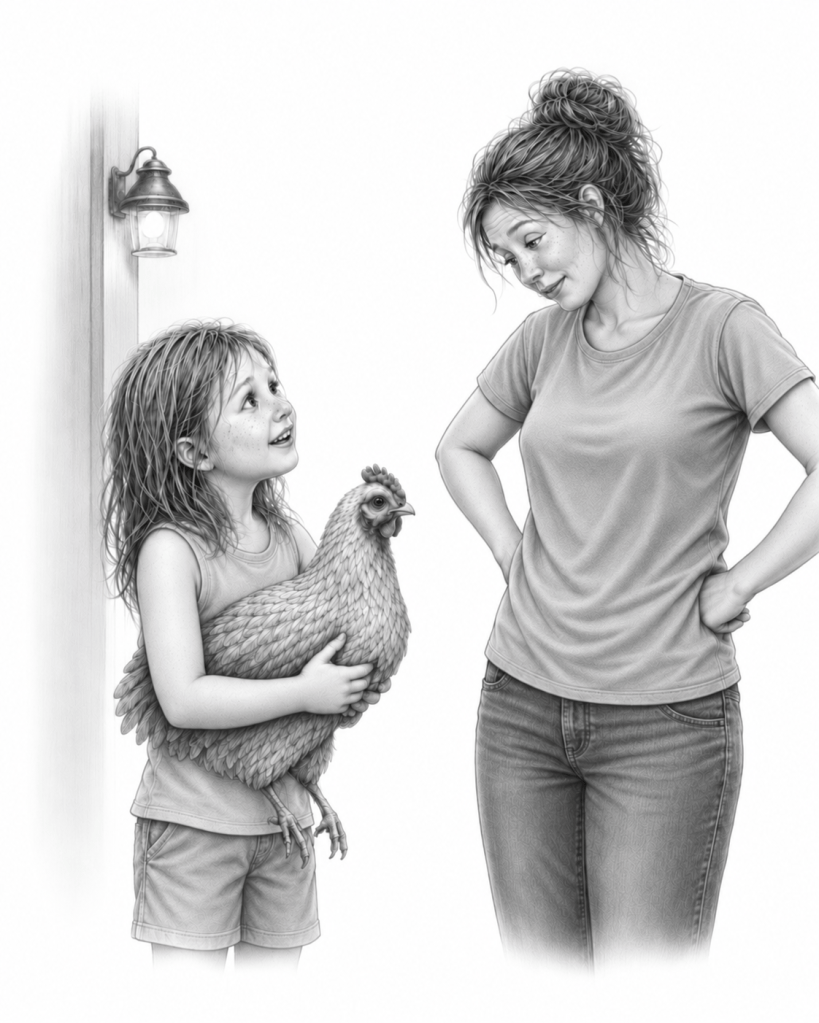
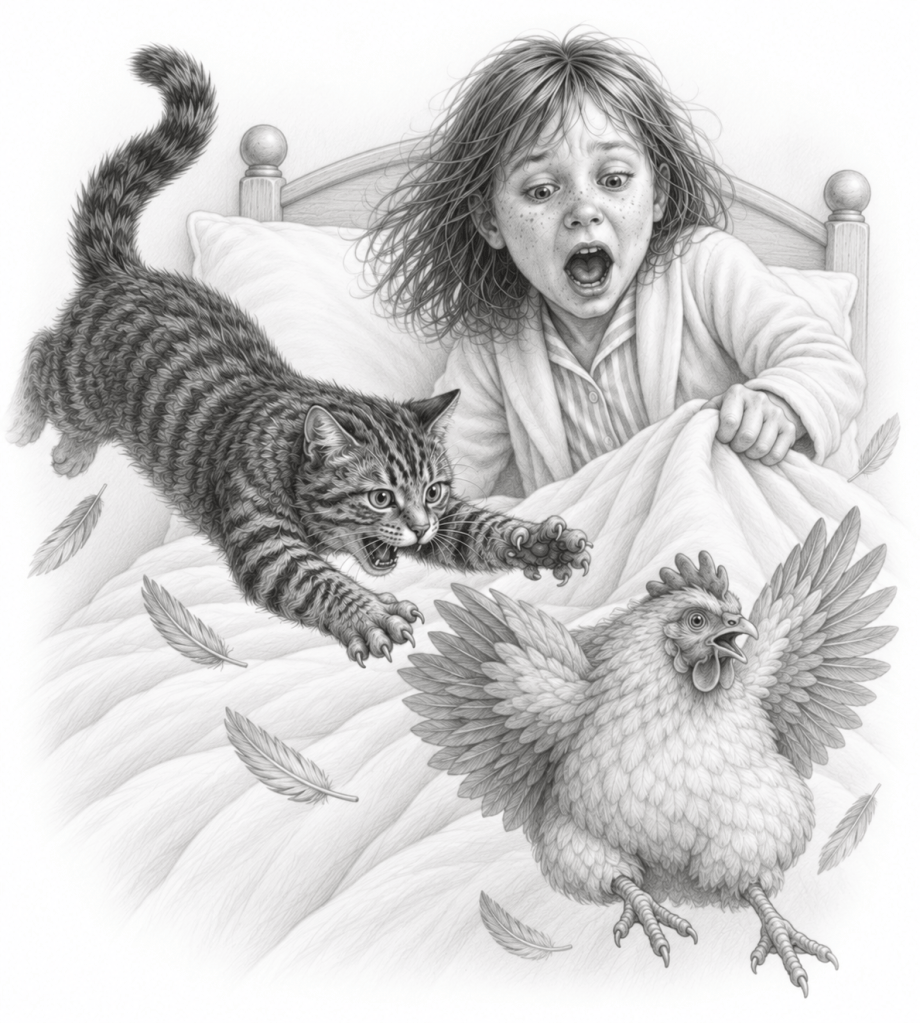
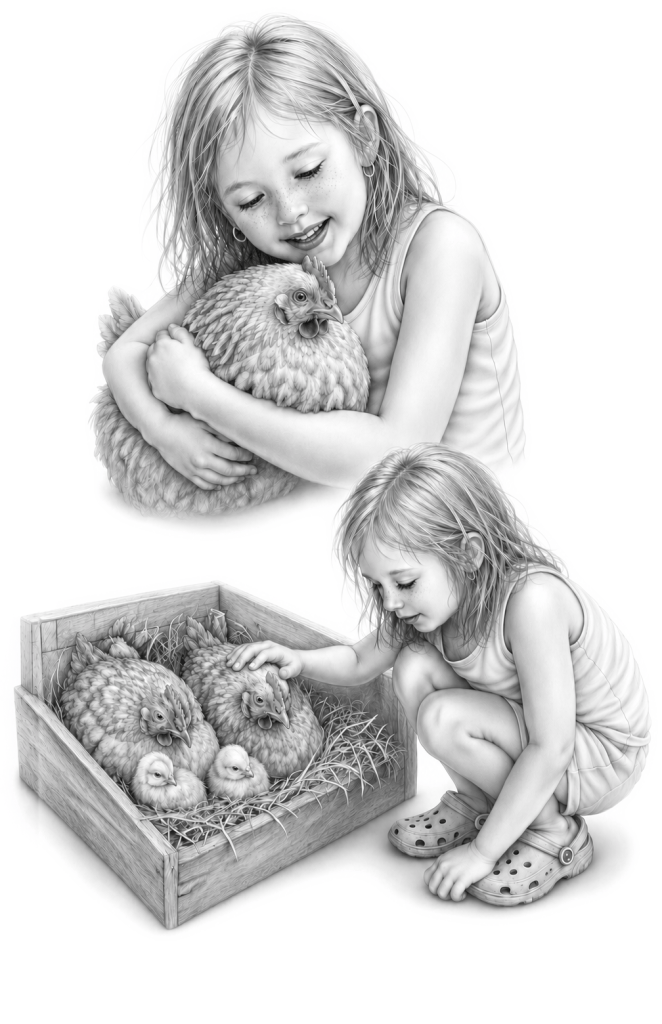
Sample images, digitally and AI created.
One of the recent pages shows Layla’s mother discovering exactly the kind of cat-and-chicken chaos promised by the title. The composition was good. The scene had energy, the white space worked, and the whole image captured the moment without drawing every feather and floorboard into submission. It was really, really close. Then I looked closer.
Mom’s expression had drifted (literally referred to as AI drift) from surprised and confused to genuinely furious. The animals were not looking toward her. Her feet needed more movement, and one revision gave her an ankle that did not appear committed to human anatomy. Then I noticed the poor cat was completely missing a foot in all of this. This is where I flip to Photoshop and begin the arduous task of adding to an image without making it look like I added to an image.
Although none of those details destroy an illustration on their own, together they changed the scene.
This is the part of creating that gets hidden behind the finished page.
Consistency in scene-to-scene appearance has been one of the bigger challenges in illustrating Layla and her chickens. Her face needs to remain hers. Her clothes need to match the time of day. The bedding, headboard, lamp, doors, and furniture must stay where the story previously placed them. She cannot wear pajamas before she decides to sneak outside, and her bed cannot be a full-size mattress in one scene and a queen in another.
When I provide a reference image and ask for the feathers or texture to be cleaned, I mean exactly that. I do not need the composition improved, the characters reimagined, or the room redecorated. A tool may see an opportunity to create something new. I am trying to bully that tool into preserving the story already being told.
The same problem arose while I was finishing a set of yoga cards for children. Several later cards did not actually show the pose named at the top. The images were attractive, but attractive is not the same as correct. A child following the card needs to see the right position. The final Namaste page also needed to belong with the rest of the set, use the established character style, and explain the idea through simple words such as peace, kindness, and gratitude.
A pretty card showing the wrong pose is not “almost right.” It is absolutely wrong.
I ran into another version of this while creating a book companion resource. A strong cover appeared quickly, but the actual learning material had not come with it. Once the inside pages were created, the font and spacing still needed attention. The lines were crowded, the overall document felt off, and it did not settle into place until it was moved into Aptos at 12 point with enough room to breathe.
That does not mean every resource needs endless polishing. At some point, perfectionism becomes another way to avoid finishing. But checking whether the pose matches its name, whether the cat still has four feet, or whether a child can comfortably read the page is not decorative fussing. It is basic quality control.
AI has permeated almost every aspect of our lives. We need to learn how to manage and direct it without allowing it to replace our words and ideas, using it instead to become better at what we already do. The learning curve is real, but not impossible. I have been “messing around” with AI for several years. It doesn’t do my job for me. It makes doing my job not only easier but, in many ways, better.
I won’t simply accept what appears on a page because it looks impressive at first glance. I have been a graphic designer since my twenties. I would never pretend to be good at it, but I am good enough that it paid my bills and supplemented my income for many years.
When I use AI on this particular project, finishing is the point where I slow down and make sure the pages meet the demands of a child. Do they engage (check), hold attention (check), and entertain (check)? Then I add my name as the author (always my own words) and credit the illustrations honestly as a collaboration between AI-generated elements, my direction, and extensive digital editing. There is nothing sloppy about this.
I will be posting another blog in the near future about the way AI has improved my skills as a teacher and afforded me more time with my students and less time fighting paperwork.


Leave a comment